In Waiʻanae, the restoration of a storied heiau has been generations in the making.
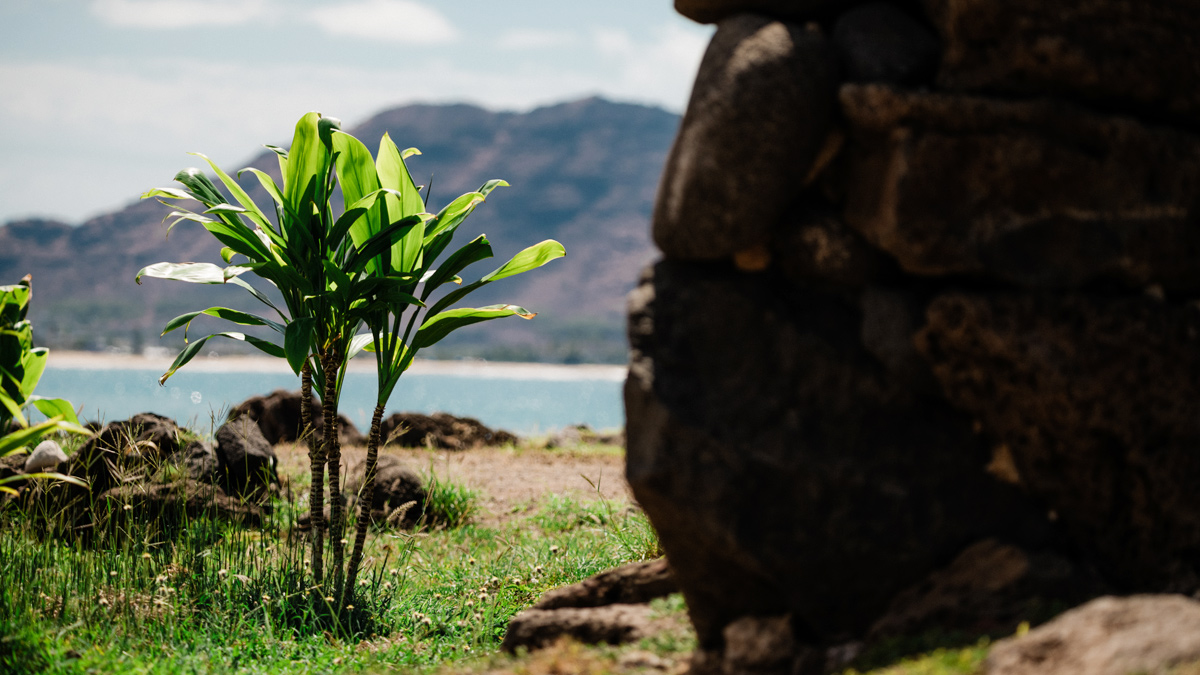
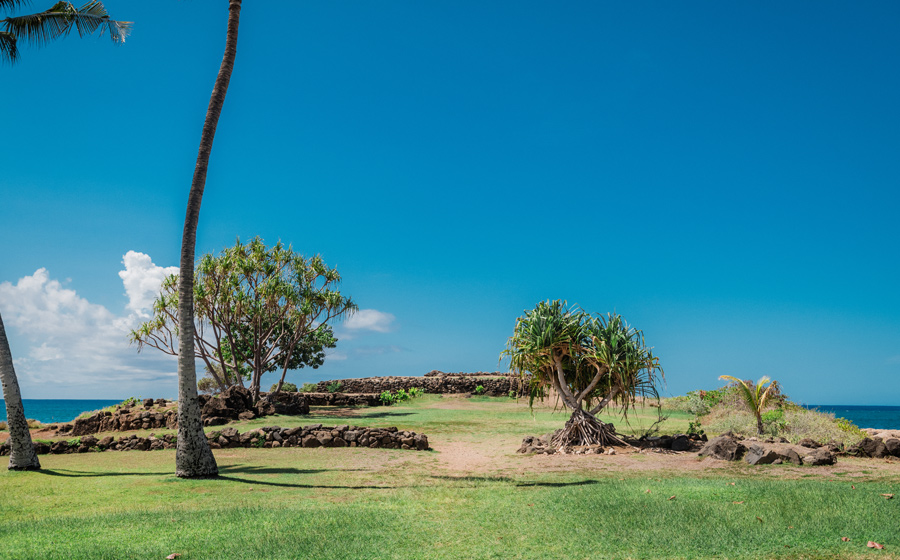
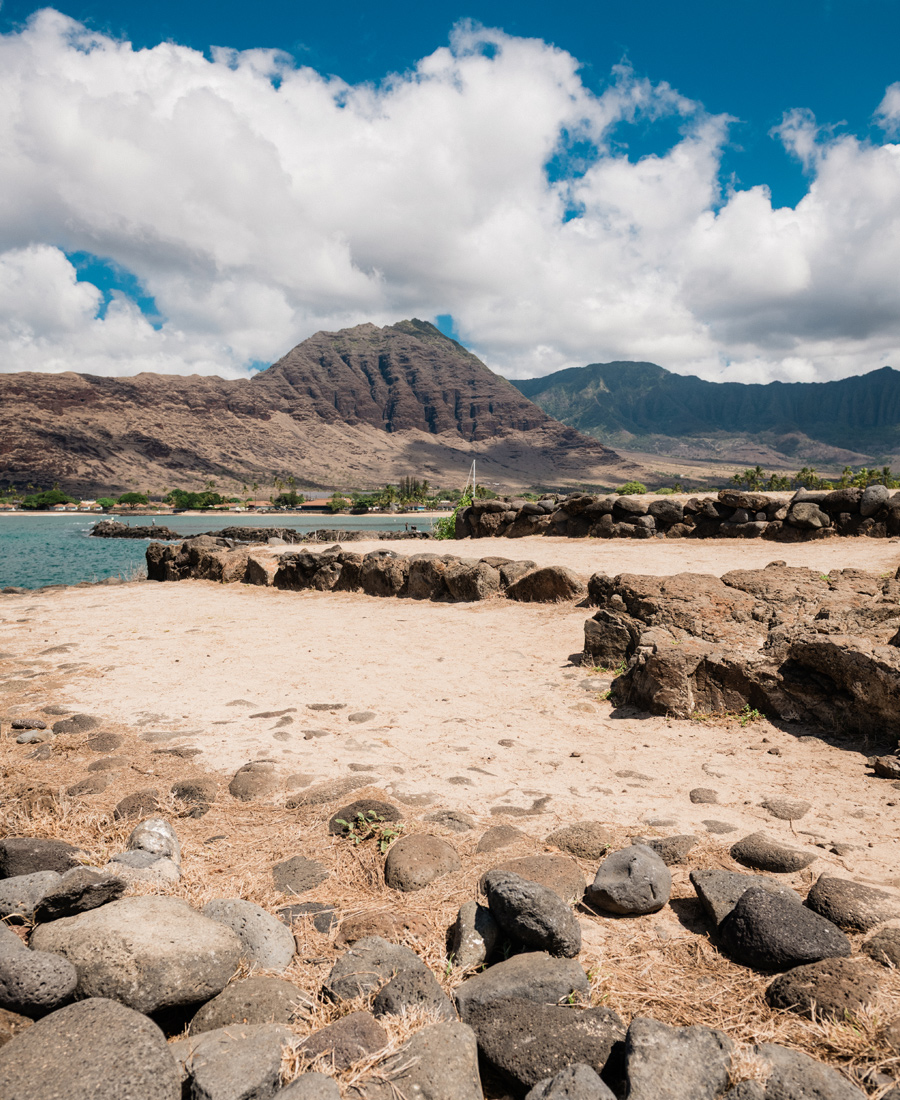
There is an old heiau at the precipice of a short-spurred peninsula along the Waiʻanae coast. Named Kū‘īlioloa, it rises more than 10 feet high, a tiered structure of lava rocks and boulders, some stones dating back centuries. California grass grows wild and tawny along its edges, and the ocean, which hems it in on three sides, is an unceasing surf against the basalt below. Climbing to the top, you meet the Pacific’s sheer immensity, a cerulean sweep that seems to run on forever. Standing at the heiau’s westernmost tip feels like standing at the end of the world.
It is said that Kamehameha I lingered here in 1795, shortly after the Battle of Nu‘uanu, before later setting sail for Kaua‘i to complete his unification of the islands, his place in history as the kingdom’s first ruler just over the horizon. Another, older story tells how the chief Lonokaeho sailed from Ra‘iātea bearing stones from Marae Taputapuātea, a Tahitian temple considered the ancestral homeland of Polynesia. After placing them at a temple on O‘ahu’s North Shore, he sailed south, pausing at Mauna Lahilahi, where he saw Kāne‘īlio Point jutting from Pōka‘i Bay. He returned north, gathered the stones, and laid them at Kāne‘īlio to build a heiau, naming it for his navigator, Kū‘īlioloa.
Today, few seem to know this history. Beachgoers at nearby Pōka‘i Bay casually pass the heiau on their walk from the parking lot to the shoreline. Some set up fishing poles along the point’s rough-hewn isthmus, Jawaiian music blaring from their speakers as they chat loudly in the heiau’s shadow. Even those who make their way to the top venture there without realizing the gravity of the place, like the young couple from Utah I witness get engaged along its terraces. When I ask later if they knew this was a heiau, the newly minted fiancé replies, “What’s that?”
I meet William Aila Jr. one sweltering Sunday at the structure’s outskirts as he waters the native naupaka shrubs growing steadily among the boulders. A hat of woven fronds shades his sunburned neck from the midday light. His faded blue shirt reads “Mālama Mākua,” a nod to the ongoing Native Hawaiian movement to protect Mākua Valley, a sacred site further up the Waiʻanae coast.
The heiau is situated on City and County of Honolulu land. Yet its care, while technically the government’s responsibility, has fallen to Waiʻanae residents like Aila, who have stepped in amid budget shortfalls and a lack of protections specific to the site. “‘Āina needs to be cared for, no different than a human being,” he says. “People need to care for ‘āina, then ‘āina will care for people.”
“‘Āina needs to be cared for, no different than a human being,” he says. “People need to care for ‘āina, then ‘āina will care for people.”
Aila and his wife have been coming to the heiau every Sunday for nearly 15 years, tending to native plants, clearing rubbish left by visitors, and, occasionally, resetting stones that have shifted with time. It’s been hard going. Often, houseless will camp atop the heiau, forcing Aila and other community members to usher them off the property. Once, an individual let their unleashed dogs roam the grounds, and they proceeded to mangle all 14 of the native ua‘u kani (wedge-tailed shearwater birds) nesting within the heiau walls.
All this ruination has been centuries in the making. When Kamehameha’s successor, Liholiho, abolished the old ways in 1819, many heiau, including Kū‘īlioloa—by then also a school for sailing and navigation—were abandoned. The true death knell came a year later, when Christian missionaries arrived from New England. Many ali‘i adopted the new faith and, urged by the missionaries, ordered heiau to be destroyed. For over a century, Kū‘īlioloa lay neglected. Then came the attack on Pearl Harbor, and with it, the U.S. military’s occupation of Kāne‘īlio Point and the heiau itself. They built a communications tower at its apex, remnants of which are still visible in the concrete trestles that punctuate the peninsula’s rock-strewn shoreline. One terrace, believed to have been a house site, was bulldozed and paved over with concrete. Many others were demolished, rendering Kū‘īlioloa unrecognizable. The land was returned to the then Territory of Hawaiʻi in 1956, after which it continued to be neglected.
By the time aloha ‘āina activist Fred Keakaokalani Cachola visited the site in the early ’70s, the heiau was reduced to a haphazard pile of stones, half-swallowed by kiawe trees. A native of Kōhala on Hawaiʻi Island, Cachola had helped restore Kōhala’s sacred spaces, including Kamehameha’s birthsite at Kokoiki. When he later settled in Waiʻanae, the first thing he asked its kūpuna (elders) was where their wahi pana—their legendary places—could be found. “They tell him about a few, but they were also the generation of ‘no touch,’” Aila recalls, referring to the century of cultural repression that took hold after the missionaries rose to influence in the 19th century.
Cachola managed to find Kū‘īlioloa, bringing along Marion Kelly, the Bishop Museum ethno-historian whose work is credited with salvaging many of Hawaiʻi’s sacred sites. Over the next two decades, Cachola, with the support of the museum and the Waiʻanae Hawaiian Civic Club, raised the heiau from ruin, their work unfolding alongside the second Hawaiian Renaissance, a renewed awakening of Hawaiian culture, language, and history. In 1976, after completing its maiden voyage to Tahiti and back, the Polynesian canoe Hōkūle‘a was moored at Kū‘īlioloa. After school, students from nearby Mākaha and Nānākuli would gather along the heiau’s newly rebuilt terraces, its ancient role as a center for navigation restored at last.
Without the city’s support, though, the Waiʻanae community could only do so much. For decades after its restoration, Cachola, and later Aila, alongside organizations like the civic club and the Royal Order of Kamehameha I, labored to keep the heiau intact. Workdays were held to reset the shifting stones. Native plants razed in a brush fire were replanted. Still, their resources weren’t enough to stave off the illegal encampments and criminal activities that plagued the site.
“Growing up in Waiʻanae, I was like, there’s so many people taking care of the heiau. Why is it still this way?” says Joseph K. Simpliano, who in 2020 co-founded the Hawaiian-led non-profit Kingdom Pathways with his wife, Carmen. Years earlier, he had been a soldier in Afghanistan returning to his native Waiʻanae for a brief leave. Seeing the abandoned cars and trash along the coastline, he says, it felt as if he’d never left the warzone. Then he learned of the heiau, its grounds overtaken by drug activity and petty crime. Shortly after retiring from the military in 2017, he joined the neighborhood board, taking the Parks & Recreation chair expressly to advocate for Kū‘īlioloa.
He quickly ran into bureaucratic red tape that stalled any effort to move forward. “I noticed that no matter how hard he tried as chair, there was a lot of pushback,” Carmen says. She encouraged him to step down, and together, they founded Kingdom Pathways to pursue the changes Joseph couldn’t achieve from within.
Joseph’s time on the neighborhood board gave him insight into the government machinery, while Carmen’s work as a paralegal helped them uncover documents affirming the heiau’s significance. In 2021, they called a meeting with the city’s park director.
Unlike earlier meetings between community groups and the city, Kingdom Pathways came prepared with informed solutions. “And that was what was different. We can complain until the sky turns purple—instead we asked the government, ‘How can us as community, boots on ground, help you?’”
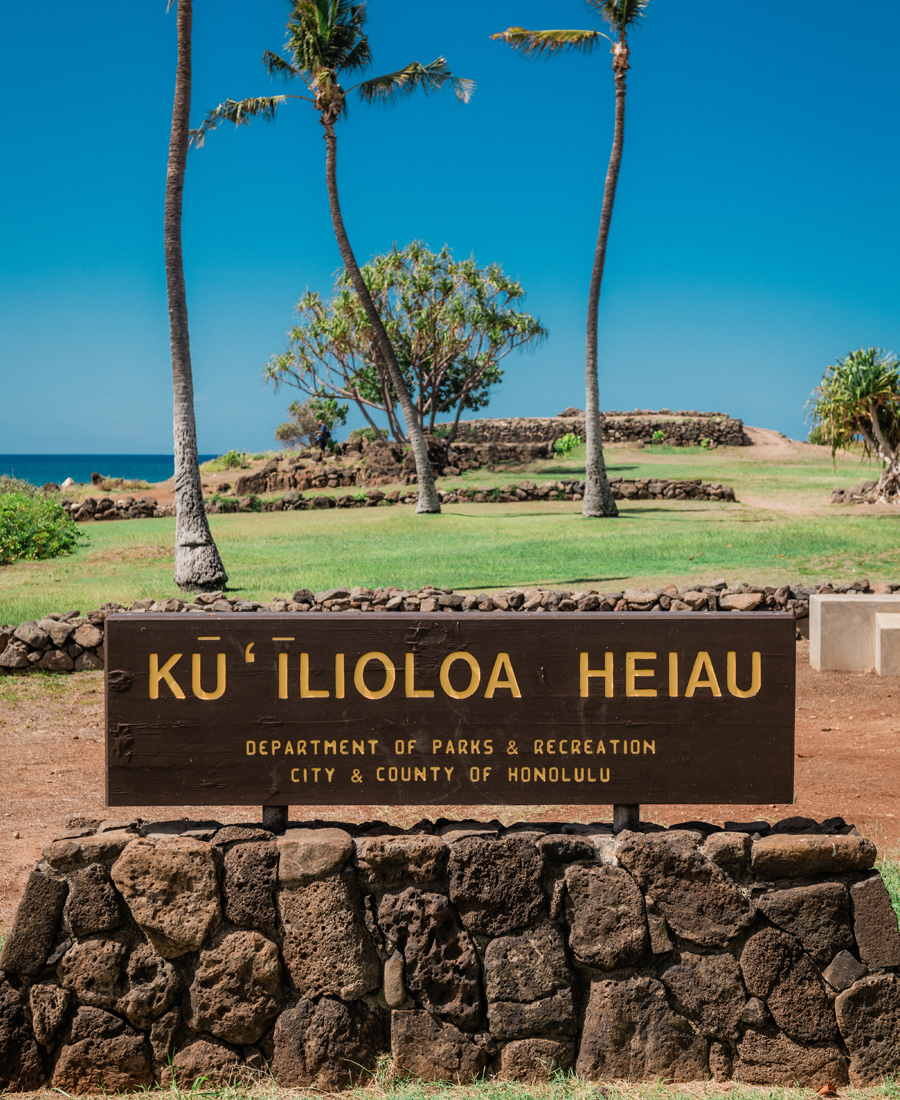
After the meeting, Carmen wrote a flurry of resolutions for the heiau, working with agencies to see them passed. One brought new signage at the entrance, identifying the site and its sacred status. Another shortened surrounding beach park hours—moving its closure from 10 p.m. to 8 p.m.—curbing much of the long-standing illicit behavior. Still, the work is far from finished. In progress is an ordinance prohibiting certain uses of the heiau grounds, including camping. The other thing that’s made a difference? Securing the release of funds long allocated for Waiʻanae but were left unused in the city’s budget since the 2000s.
“Tell me one other heiau that has these problems,” Carmen says. “I think that really hammers it home, right? But there are solutions. It may take a couple of years, but it can be done.”
For More, Visit kingdompathways.info.